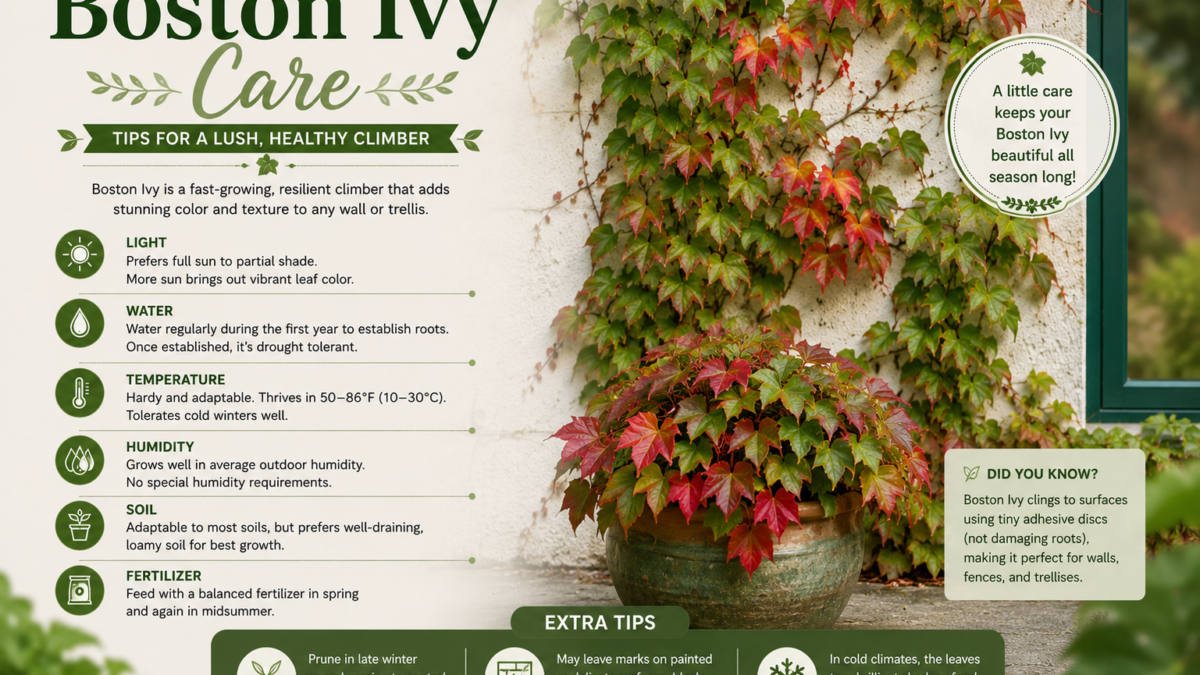
Boston ivy is honestly one of the easier houseplants to keep alive. It wants three things: bright indirect light, water every 4 days, and basically nothing else. Everything beyond that is just details. And yeah, the details matter, so that’s what we’re covering here.
Quick facts
| Latin name | Nephrolepis exaltata |
|---|---|
| Light | Bright indirect; avoid direct sun |
| Water | Roughly every 4 days. Keep consistently moist; very intolerant of drying out. |
| Humidity | 60-80% |
| Temperature | 16-22 °C |
| Soil | Peat-rich, moisture-retentive mix |
| Fertilizer | Quarter-strength every 4 weeks |
| Pet safe? | Non-toxic to cats and dogs |
Light
Bright indirect; avoid direct sun. Too dark and the plant slows down or stops pushing new growth. Too much direct sun and you get scorched leaves with bleached patches.
An easy test: hold your hand 30 cm above the plant at midday. A sharp shadow means bright light. A soft fuzzy shadow is medium. No shadow at all is too dim for most species.
Watering
Keep consistently moist; very intolerant of drying out.
Forget weekly schedules. Boston ivy in a warm bright spot in summer might need water every 2 to 8 days, and once every 3 weeks in winter. The finger test always beats the calendar.
Signs of overwatering: yellowing lower leaves, soft mushy base, fungus gnats. Signs of underwatering: drooping, curling, crispy edges. If you’re not sure, err on the dry side.
Humidity and temperature
Boston ivy likes 60-80% humidity. Most homes in winter sit closer to 25-35%, which is why crispy leaf tips are a common complaint. Group plants together to raise local humidity, or run a small humidifier in the corner. Misting is theatre. Don’t bother.
Keep room temperature between 16-22 °C and away from cold drafts, AC vents, and radiators.
Soil and repotting
Use peat-rich, moisture-retentive mix. Drainage matters more than any specific brand. Repot every 1-2 years in spring, going up one pot size only. A pot that is too big traps water around the roots and kills the plant faster than any pest.
Fertilizing
Quarter-strength every 4 weeks. Skip fertilizer in winter. Plants are dormant and excess nutrients sit in the soil and burn the roots.
Propagation
Division of root ball. Most cuttings root within 2-4 weeks in spring. Use a jar of room-temperature water and change it weekly to prevent rot.
Common problems
- Browning fronds (low humidity)
- Pale fronds (too much sun)
- Constant leaf drop (dryness)
For a deeper diagnostic, see our boston ivy yellow leaves guide and root rot recovery guide.
Pet safety
Non-toxic to cats and dogs See the ASPCA listing for current toxicity data.
Bringing a new boston ivy home
The first two weeks are the hardest. Boston ivy adjusts to your home’s light, humidity, and watering pattern, and some leaf drop or stress is normal. Pick a spot and leave it. Resist the urge to move it around looking for the perfect light. Plants acclimate by sending out roots toward water and tilting growth toward light, and every move resets that adaptation. Water sparingly during this period because the root system is doing more reconnecting than absorbing. After two to three weeks, you can settle into a normal routine.
If you see browning fronds in the first week, do not panic. That is almost always shipping stress or acclimation, not a care problem. Watch for two more weeks before changing anything.
Seasonal care
Boston ivy grows on a yearly cycle that most beginners forget:
- Spring (March-May): Active growth restarts. Increase watering frequency, resume fertilizing, and consider repotting if the plant outgrew its container last year. New leaves should appear within 4-6 weeks of the days getting longer.
- Summer (June-August): Peak growing season. Watch for faster soil drying in hot weather. Aim for watering roughly every 2 days. Move away from windows during heatwaves to avoid scorching.
- Autumn (September-November): Growth slows. Cut fertilizer to half. Watering frequency drops as light decreases. This is when most overwatering happens because people keep summer schedules.
- Winter (December-February): Near-dormancy. Water roughly every 11 days. No fertilizer. Move away from cold windows and away from heating vents.
Where to put boston ivy in your home
The exact spot matters more than the species. Good candidate locations:
- 1-2 metres from a south or east-facing window (best for most species, boston ivy included).
- On a bookshelf at chest height near a window, with the plant facing inward (so trailing growth shows).
- A bathroom with a window if humidity is a priority and the plant is humidity-loving.
Bad candidate locations:
- Directly above a radiator or AC vent. The constant temperature swing scorches leaves and dries soil fast.
- A windowless hallway. Light is the single biggest factor in plant survival, and there is no substitute for some daylight.
- Right against window glass in winter. Cold conducts through glass and burns leaves overnight.
How to tell if your boston ivy is healthy
Three weekly checks take 90 seconds:
- New growth. A healthy plant pushes a new leaf or shoot every 2-4 weeks in spring and summer. If it has not produced anything new in 8 weeks of warm weather, conditions are off.
- Leaf colour and firmness. Healthy leaves are firm, the colour matches when you bought the plant, and they hold their shape. Soft, faded, or limp leaves are early warning.
- Soil and roots. Stick a finger 3 cm into the soil. Damp but not soaked is correct most of the time. White roots gently visible through the drainage hole are a good sign. Brown mushy roots showing through the hole need immediate attention.
Choosing a healthy specimen at the nursery
What to inspect before buying boston ivy:
- Lift the pot. A plant that has been recently watered and is too light for its size has poor root development. Pass on it.
- Look under the leaves. Sticky residue, webbing, or small moving dots mean pests, and you are buying yourself a quarantine and treatment job.
- Check the soil surface for fungus gnats (tiny flying insects) and the rim of the pot for white crusty buildup (mineral salts, a sign of over-fertilizing).
- Avoid plants displayed under fluorescent overhead lighting in cool corners. They are usually already declining and will struggle to recover at home.
Pay 20-40% more at a specialty nursery if you can. The plants are healthier, the staff knows the species, and the survival rate is much higher than big-box stores.
What to read next
Got your boston ivy sorted? Check these out too:
- Pet-safe houseplants for cat and dog owners
- The best low-light houseplants
- Indoor plant care for beginners
[HUMAN: one sentence in your voice about your experience with boston ivy. Even “I have three of these on the bookshelf and they thrive on neglect” works.]
How often should I water boston ivy?
Roughly every 4 days, but the finger test beats any schedule. Keep consistently moist; very intolerant of drying out.
Is boston ivy safe for cats and dogs?
Non-toxic to cats and dogs
Why are my boston ivy leaves yellow?
Browning fronds (low humidity)
How fast does boston ivy grow?
Moderate; constantly sheds leaflets
What kind of light does boston ivy need?
Bright indirect; avoid direct sun